Accountability and control in times of pandemic: challenges and dialogue between the scientific and professional fields
DOI:
https://doi.org/10.36428/revistadacgu.v12i22.392Abstract
The advent of the Covid-19 pandemic and the economic, social, and political consequences of combating it stimulate debates about public action and the controls exercised on it, leading to questions about the permanence, functioning, and effectiveness of accountability mechanisms in times of public calamity.
Those who study public action control systems know that there is a tension between the timeliness of deliveries, the efficiency of public services, and the effectiveness of the control mechanisms. This worsens in crisis times when emergencies impose short deadlines for deliveries, sub-optimal provision for beneficiaries, and loosening of controls.
A similar obstacle is imposed on the production of knowledge about emerging facts when it is not possible to go back in time that allows consistent historical series, diversified readings, solid inferences, and in-depth analyses. The speed of events requires the speed of action and reflection or vice versa. In both poles, the dialogue between professionals and academics is central to dealing with challenges, minimizing risks, and allowing the formulation and implementation of alternatives.
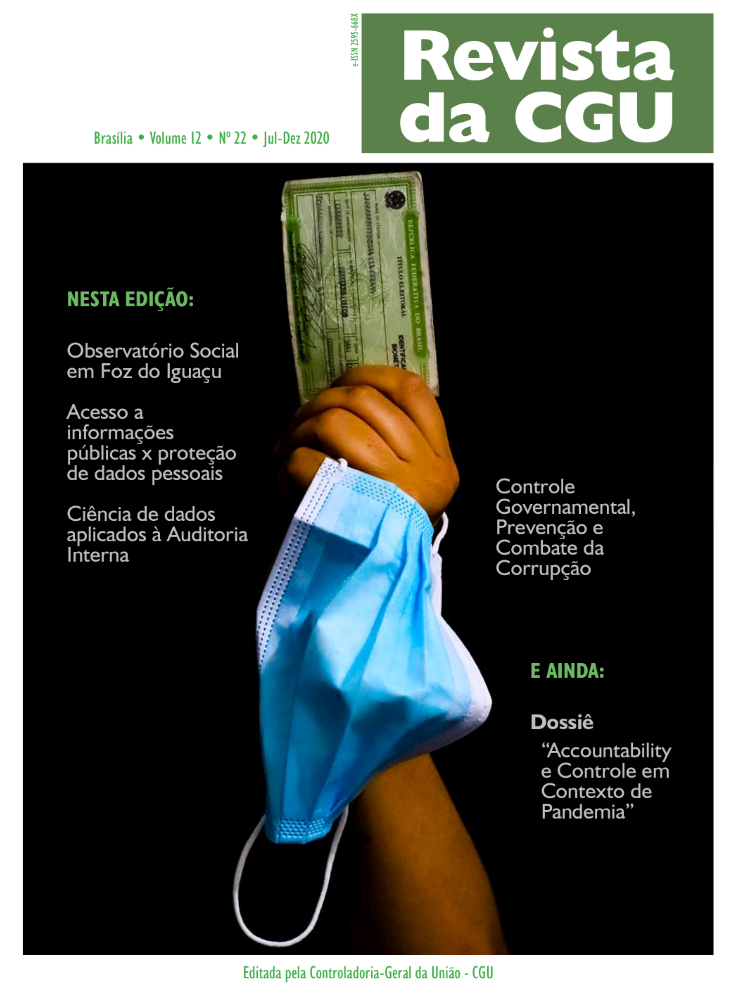
Such challenges drive the dossier dedicated to the theme of control and accountability in the pandemic context, whose proposal and papers address how public administration in Brazil, Spain, and the United States has been dealing with these issues from two perspectives. On the one hand, the urgency of actions that the pandemic demands to respond to the social, economic, and health effects caused by COVID-19. On the other hand, the extent to which the necessary procedures for respecting laws and transparency continue to be followed without creating a burden on society.
A scientific journal devoted to the study of public administration also needs to give quick answers to the questions that arise in the scientific and professional fields about facing crises. The purpose of Revista da CGU with this dossier was to offer an opportunity for reflection and dialogue between these fields on issues related to accountability and control in the context of the pandemic.
Downloads
Downloads
Published
Issue
Section
License
Copyright (c) 2020 Revista da CGU

This work is licensed under a Creative Commons Attribution 4.0 International License.
The Revista da CGU follows the Creative Commons Attribution 4.0 International License (CC BY), which allows the use and sharing of published works with mandatory indication of authors and sources. Contents published until 2019 have generic permission for use and sharing with mandatory indication of authorship and source.
We highlight some essential and non-exhaustive points related:
- The submission of the proposal implies a commitment not to submit it to another journal and authorizes if approved, its publication.
- The submission of the proposal also implies that the author(s) agrees with the publication, without resulting in remuneration, reimbursement, or compensation of any kind.
- The published texts are the responsibility of the authors and do not necessarily represent the opinion of the journal.
- Responsibility for any plagiarism is the responsibility of the author(s).
- The person responsible for the submission declares, under the penalties of the Law, that the information on the authorship of the work is complete and correct.
Also highlighted are the items related to our Editorial Policies, in particular on the Focus and Scope, Publication Ethics, Peer Review Process, and Open Access Policy.