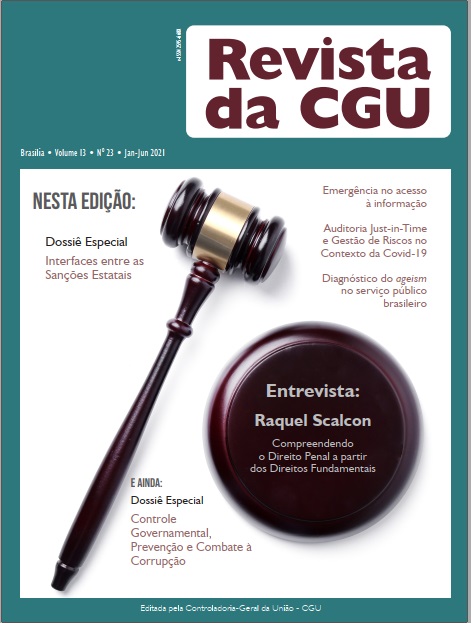
Emergency in Access to Information: The Use of the Access to Information Law in the Federal Government During the Covid-19 Pandemic
DOI:
https://doi.org/10.36428/revistadacgu.v13i23.334Keywords:
Access to Information Law, Covid-19, TransparencyAbstract
The research carried out within the scope of the project “Covid-19: access to public information”, monitors and analyzes the texts of information requests addressed to the federal government related to Covid-19 and the respective responses, through the Electronic System of the Citizen Information Service, created to comply with the Access to Information Law (AIL). The partial results of the research point out three strong tones regarding the purposes of the requests: request clarifications, demand explanations and measures and ask for economic protection. The studies about the first half of 2020 showed that the majority of requests for information dealt with emergency aid. On the side of the answers, it is noteworthy that the overwhelming majority was officially reported as “forwarding to the e-Ombudsman” or “not being considered a request for information”. Concludes on the need for a broad campaign of clarification on which channel to turn between e-SIC and e-Ouv, not only for the citizen but also for the federal public bureaucracy.
Downloads
References
AYLLÓN, S.L. El acceso a la información como um derecho fundamental: la reforma al artículo 6º de la Constitución mexicana. Ciudad de México: INAI, 2017 (Cuadernos de Transparencia, 17).
BRASIL. Lei nº 12.527, de 18 de novembro de 2011. Diário Oficial da União, Brasília, 18 nov. 2011.
MALIN, Ana Maria Barcellos et al. Covid-19: acesso à informação pública. Informação em tempos de pandemia. n. 1 – abr. Rio de Janeiro: Observatório de Gestão Pública da Informação, 2020a.
______. Covid-19: acesso à informação pública. LAI na pandemia: o Ministério da Cidadania frente aos pedidos de proteção econômica. n. 2 – maio. Rio de Janeiro: Observatório de Gestão Pública da Informação, 2020b.
______. Covid-19: acesso à informação pública. LAI na pandemia: a desorganização das informações do governo como obstáculo ao recebimento do auxílio emergencial. n. 3 – jun. Rio de Janeiro: Observatório de Gestão Pública da Informação, 2020c.
______. Covid-19: acesso à informação pública. LAI na pandemia: somente 16% dos pedidos sobre o novo coronavírus com acesso concedido em junho. n. 4 – jul. Rio de Janeiro: Observatório de Gestão Pública da Informação, 2020d.
MORAES, Roque. Análise de conteúdo. Revista Educação, Porto Alegre, v. 22, n. 37, p. 7-32, 1999.
VERGARA, Rodolfo. La transparencia como problema. Ciudad de México: INAI, 2015 (Cuadernos de Transparencia, 5).
Downloads
Published
Issue
Section
License
Copyright (c) 2021 Revista da CGU

This work is licensed under a Creative Commons Attribution 4.0 International License.
The Revista da CGU follows the Creative Commons Attribution 4.0 International License (CC BY), which allows the use and sharing of published works with mandatory indication of authors and sources. Contents published until 2019 have generic permission for use and sharing with mandatory indication of authorship and source.
We highlight some essential and non-exhaustive points related:
- The submission of the proposal implies a commitment not to submit it to another journal and authorizes if approved, its publication.
- The submission of the proposal also implies that the author(s) agrees with the publication, without resulting in remuneration, reimbursement, or compensation of any kind.
- The published texts are the responsibility of the authors and do not necessarily represent the opinion of the journal.
- Responsibility for any plagiarism is the responsibility of the author(s).
- The person responsible for the submission declares, under the penalties of the Law, that the information on the authorship of the work is complete and correct.
Also highlighted are the items related to our Editorial Policies, in particular on the Focus and Scope, Publication Ethics, Peer Review Process, and Open Access Policy.